
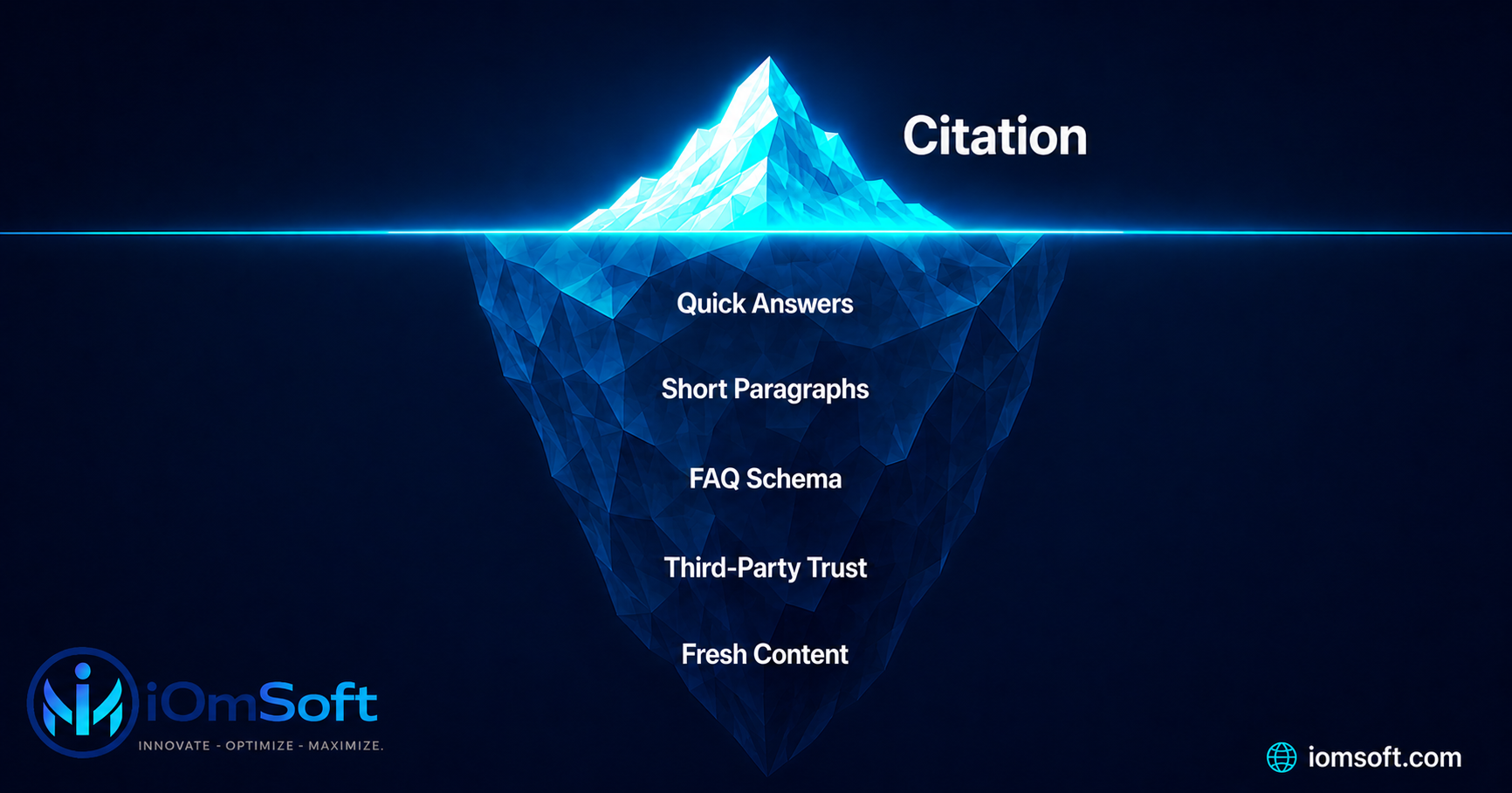
How to Get Your Website Cited by AI: A Practical GEO Guide.
Getting cited by AI systems like ChatGPT, Perplexity, Google’s AI Overviews, and Grok depends on three things working together: content structured for extraction (short answers, lists, tables), technical signals AI can parse (schema markup, clean HTML), and trust signals from outside your own website (third-party mentions, reviews, citations). Pages with structured lists, quotes, and statistics see 30-40% higher visibility in AI responses, according to Princeton’s GEO research. The rest of this guide walks through exactly how to build all three.
Getting cited by AI systems like ChatGPT, Perplexity, Google’s AI Overviews, and Grok depends on three things working together: content structured for extraction (short answers, lists, tables), technical signals AI can parse (schema markup, clean HTML), and trust signals from outside your own website (third-party mentions, reviews, citations). Pages with structured lists, quotes, and statistics see 30-40% higher visibility in AI responses, according to Princeton’s GEO research. The rest of this guide walks through exactly how to build all three.
The AI Answer-Engine Landscape, Briefly
“AI search” isn’t one thing anymore, and treating it that way undersells what’s actually happening. Four platforms matter most for GEO right now, each working a little differently:
ChatGPT — the largest consumer AI assistant by user base - is increasingly used as a starting point for research and recommendations instead of a traditional search engine.
Perplexity — arguably the purest “answer engine” of the group, built specifically around citing sources for every answer it gives, and known for routing a single query across several underlying models to produce the best response.
Google’s AI Overviews and AI Mode — Google’s own AI-generated answers, appearing directly inside regular search results for a large and growing share of queries.
Grok — integrated directly into X, with real-time access to that platform’s content, which gives it a distinct data source the others don’t have.
Each of these pulls from different sources and weighs signals somewhat differently, but the underlying GEO practices in this guide — extractable structure, clean technical signals, and third-party trust — improve citation odds across all four, not just one.
What GEO Actually Means
Generative Engine Optimization, or GEO, is the practice of structuring content so AI-generated answers surface and cite your brand — instead of AI answering the question itself and never mentioning you at all.
The terminology hasn’t fully settled yet. You’ll see it called GEO, AEO (Answer Engine Optimization), or just “AI SEO.” All three describe the same underlying discipline. This guide uses GEO throughout.
One number explains why this matters right now: fewer than 12% of marketing teams currently have a documented strategy for appearing in AI-generated answers, even as AI-driven research increasingly influences purchase decisions. That gap is the opportunity. Citation authority compounds over time, the same way domain authority did for traditional SEO — starting now matters more than starting perfectly.
The Mechanic Underneath Everything: Query Fan-Out
Here’s what’s actually happening when someone asks an AI system a question. The AI doesn’t run one search and summarize it. It breaks the question into several smaller sub-queries — sometimes five, sometimes closer to eleven — and searches for each one in parallel before combining the results into a single answer.
This is called query fan-out, and it’s the single biggest reason GEO differs from traditional SEO. Ranking for one keyword was always the traditional goal. But if an AI system fans a question out into eleven sub-queries, ranking for one of them doesn’t guarantee inclusion in the final answer — comprehensive coverage across the whole topic cluster does.
Practically, this means a page trying to get cited shouldn’t just answer the headline question. It also needs to answer the follow-up questions a real user would have — the ones the AI is silently checking for in parallel.
The Content Structure That Actually Gets Cited
Research analyzing thousands of real AI queries found a clear pattern: pages with structured lists, quotes, and statistics had 30-40% higher visibility in AI responses. Separate research puts more precise numbers on individual elements — quotations lift citation likelihood by 41%, statistics by 32%, and inline citations by 30%.
The best-performing pages follow a two-layer structure:
Layer 1 — the Quick Answer (first 150-200 words). A direct, complete answer to the main question, before any throat-clearing or context. No long intro paragraph first. This block should work standalone, since it’s often the exact piece an AI system extracts.
Layer 2 — the deep dive (everything after). Full detail, supporting evidence, comparisons, and nuance for readers who want more than the summary.
A few structural rules worth following throughout, not just in the opening:
Short paragraphs. Two to three sentences maximum. Long blocks of unbroken text are harder for AI systems to parse and less likely to be extracted cleanly.
Lead with the answer in every section, not just the article as a whole. Don’t bury a section’s key point under three sentences of setup.
Use genuine lists and tables wherever the content supports it. One analysis found 80% of AI-cited pages use lists or other structured elements — structure isn’t decoration here, it’s what makes content extractable.
What Doesn’t Get Cited (This Part Surprises Most People)
This is worth knowing before you invest effort in the wrong format. One dataset analyzing AI citation patterns found that plain brand or service pages generated close to zero citations on their own. Standalone case studies performed similarly poorly — unless the same data was embedded inside a broader, list-formatted piece, in which case it performed much better.
The practical takeaway: a page that’s purely “About Us” or “Our Services,” with no genuinely useful standalone information, is unlikely to ever get cited by an AI system, no matter how well it’s written. AI systems cite content that answers a question — not content that describes a company.
Technical Signals: Schema Markup
Structured data doesn’t just help traditional search engines understand a page — it gives AI systems a clean, unambiguous signal about what the content actually is.
At minimum, a page built for AI citation should carry:
Schema type | What it signals |
Article | Confirms this is genuine editorial content, not a product or listing page |
FAQPage | Marks specific question-and-answer pairs as directly extractable |
ItemList | Signals a structured list or ranked set of items, which AI systems can lift cleanly |
Layering multiple relevant schema types on the same page — rather than picking just one — is increasingly standard practice for content aiming specifically at AI citation, not just traditional search ranking.
Trust Signals From Outside Your Own Website
Nothing you do on your own site fully replaces this one: third-party trust signals have been found to lift AI citation likelihood by roughly 75 times. That’s not a typo-sized number — it’s the largest single factor in the research.
AI systems appear to apply a form of corroboration check: if a business or claim is mentioned positively across multiple independent sources — review sites, directories, trade publications, other websites — that consistency is treated as a much stronger trust signal than anything the business says about itself.
This is exactly why the unglamorous work of building a presence across relevant directories, earning genuine reviews, and getting mentioned on other credible sites matters more for AI visibility than it ever did for classic SEO alone. It’s also where a coordinated SEO strategy needs to extend beyond just the website itself.
Content Freshness Isn’t Optional
AI citation isn’t a one-time achievement. New content can enter AI citation pools within roughly 3-5 business days of publishing — genuinely fast, compared to how long traditional SEO rankings can take to establish. But the reverse is also true: content decays. Pages that go stale lose citation priority over time, even after they’ve been cited before.
The practical implication: treat a GEO-focused page as something to revisit roughly every 90 days — refreshing statistics, checking claims are still accurate, and updating anything time-sensitive — rather than a one-time publish-and-forget piece.
A Practical Starting Checklist
If you’re implementing this for the first time, in order of impact:
Add a Quick Answer block to your most important pages — 150-200 words, directly answering the core question, positioned before any other content.
Break up long paragraphs across your site into 2-3 sentence blocks.
Add FAQ sections to key pages, formatted to match real questions people actually ask, with FAQPage schema behind them.
Build genuine third-party presence — directories, reviews, mentions — rather than relying solely on your own site’s claims about itself.
Identify your thin brand/service pages and either enrich them with genuinely useful standalone information, or accept they’ll mainly serve internal navigation rather than AI citation.
Calendar a content refresh cycle — quarterly is a reasonable starting cadence for anything citing statistics or time-sensitive claims.
This is also, practically, the core of what real digital marketing services need to cover now — GEO isn’t a separate discipline bolted onto SEO; it’s become part of the same job.
Frequently Asked Questions
Is GEO different from SEO?
They overlap significantly but aren’t identical. Traditional SEO optimizes for ranking position; GEO optimizes for being extracted and cited inside an AI-generated answer. Strong SEO fundamentals still help — the pages AI systems pull from are generally pages that already rank reasonably well — but ranking well is no longer sufficient by itself.
How long does it take to see results from GEO?
New content can enter AI citation pools within 3-5 business days, though building consistent, reliable citation frequency takes longer and depends on how competitive the topic is and how much third-party trust the site already has.
Do I need to choose between traditional SEO and GEO?
No — they’re complementary, not competing. The strongest approach treats GEO as an extension of solid SEO fundamentals, not a replacement for them.
What’s the single highest-impact change to make first?
Based on the research here, adding a genuine Quick Answer block — a direct, complete answer in the first 150-200 words — to your most important existing pages is the fastest, lowest-effort starting point.
The Bottom Line
GEO is still early enough that most businesses haven’t started — which means the businesses that do this work properly now have a real, time-limited head start before it becomes as competitive as traditional SEO already is. The mechanics aren’t mysterious: structure content to be extractable, back it up with genuine technical signals, and build trust from outside your own website, not just within it.
This is also, honestly, the kind of work that benefits from AI automation done thoughtfully — structuring content, tracking citation performance, and keeping pages fresh at scale is exactly the kind of repetitive, ongoing work that’s easier to sustain with the right tooling behind it.
Want an honest look at how citation-ready your current website actually is? As a custom software development company in Mohali, this is exactly the kind of technical work we do — for our own site and our clients’ both, using AI as one tool among several, not as the whole pitch. We’re happy to take a look and tell you plainly what’s working and what isn’t. Get in touch →
Got a question about this post or your own project?